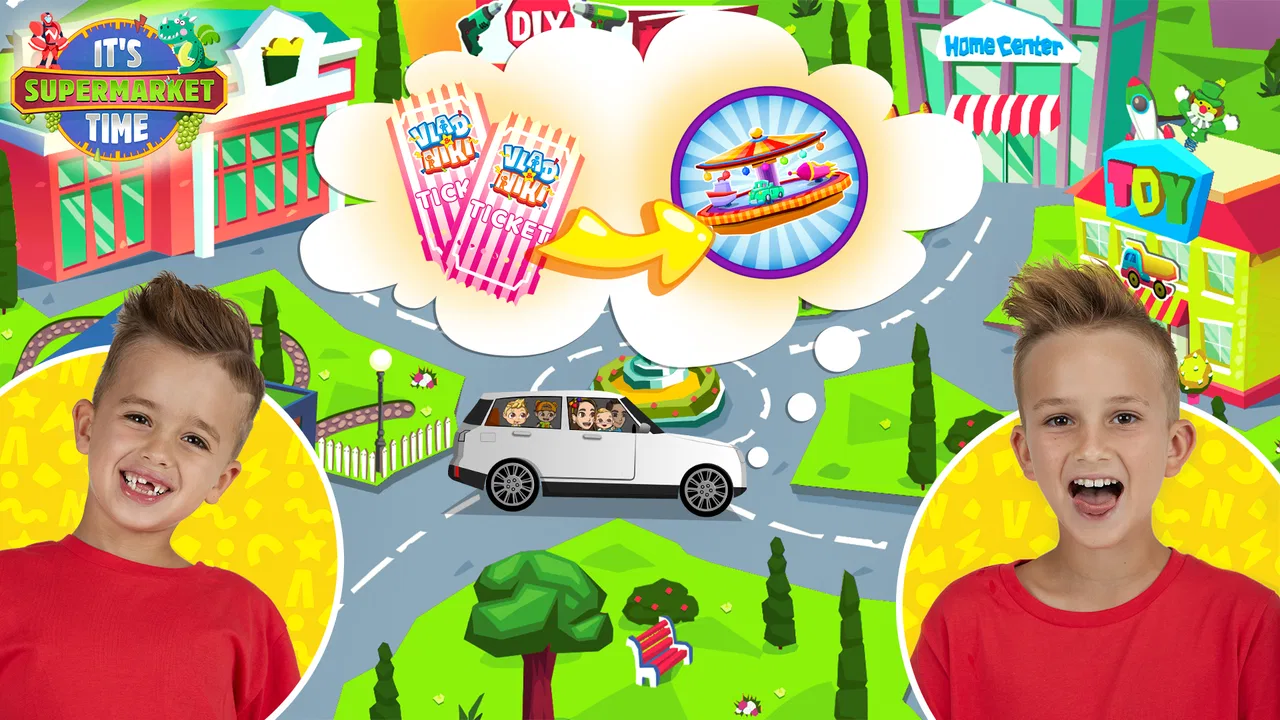
Vlad & Niki Supermarket game
- 4.7
- Rating
- 50.00M
- Installs
- Free
- Price

 Analysis by App-foxy
I spent time with Vlad & Niki Supermarket as a light educational game for young children, and my first impression was clear: it is built around the familiar excitement of going shopping, but turns that everyday activity into simple play. Instead of asking a child to sit through a formal lesson, it uses the recognizable world of a supermarket and the presence of Vlad and Nikita to make basic interactions feel approachable.
The game comes from Hippo Kids Games and is listed in the Educational category. It is free to start, carries an Everyone age rating, and has reached over 50 million installs. Those details tell me who the intended audience is: families looking for an accessible first game rather than older children searching for deep strategy, demanding puzzles, or a long adventure.
What makes it worth considering is not complexity. The appeal is the low-pressure setting, the child-friendly theme, and the way ordinary shopping can become a reason to notice objects, follow a sequence, and make small choices. I would not present it as a replacement for structured learning, but I can see why it works as a short activity between more demanding parts of a child’s day.
You May Also Like

 AccuWeather: Weather Radar
AccuWeather Review: A Quick, Clear Forecast for Everyday Decisions
For everyday plans, the best forecast is the one you can understand quickly. AccuWeather makes rain timing, radar, and local conditions easy to act on, with a few trade-offs.

 Hill Climb Racing
Why Hill Climb Racing Still Turns Crashes Into One More Run
A tiny car, a bumpy hill and one more upgrade: Hill Climb Racing keeps resurfacing because its simple chaos makes every near-miss feel personal.

 AliExpress - Shopping App
AliExpress Makes Global Shopping Feel Personal, but Shoppers Bear the Risk
AliExpress turns a global marketplace into a pocket-sized discovery engine. Its reach is useful, its shopping loop compelling, and its trade-offs easy to miss.

 Lords Mobile: Kingdom Wars
Lords Mobile Is a Kingdom-Building Routine, Not a Quick Match
A case-by-case verdict on the building, battles, device demands, and social commitments that make Lords Mobile rewarding for some players and exhausting for others.

 PDF Scanner app - TapScanner
TapScanner Makes Paperwork Easier to Capture, Check, and Share
TapScanner makes scanning with a phone feel less like a rescue operation and more like a dependable step in getting work done. Its capture tools are useful, though not flawless.

 Block Blast!
 Shows How Much a Puzzle Game Can Leave Out
A quiet grid game shows why puzzle players increasingly value instant clarity, repeatable skill and low-pressure play—and where the genre still needs to catch up.
More From Our News Desk
View All News


Shopping becomes the central play idea
The supermarket setting gives the game an advantage over many abstract educational apps. A child already understands the basic idea of entering a shop, looking around, choosing something, and finishing the visit. That familiarity reduces the amount of explanation needed before play can begin. The child can focus on the activity instead of learning an unfamiliar fictional world first.
Vlad and Nikita also make the experience feel more like a character-led outing than a worksheet. For a young player who recognizes the characters, that can be an important reason to return. The theme does a useful job of lowering resistance: “let’s go shopping” sounds like an invitation to play, not a lesson disguised as homework.
In my experience, this kind of design is most effective when an adult treats it as a conversation starter. I would sit beside a child and ask what they think the characters should choose, what they notice on the screen, or what might happen next. The game can then support vocabulary and attention without turning every tap into a test.
That distinction matters. The app is educational in the broad, child-friendly sense, but I would not expect it to teach advanced mathematics, reading fluency, or detailed consumer skills. Its value is in giving a child a simple context for recognition, ordering actions, and making decisions. Parents who want a complete curriculum should look elsewhere; parents who want an approachable shopping-themed activity may find the format much better suited.
How I would use it during an ordinary day
A realistic use case would be a child waiting while a parent prepares dinner. Rather than handing over a complicated game, I would open this one for a short session and stay nearby. Afterward, I might connect the play to the real supermarket: asking the child to spot a similar item, remember where it belongs, or help place a few groceries in a bag. The digital activity becomes more useful when it leads into something tangible.
It can also fit a quiet transition, such as after returning from school or before bedtime, provided the child responds well to screen play at that time. The simple theme makes it easier to explain what the child is doing, and the familiar characters can help the activity feel less demanding than a conventional learning app.
I would avoid using it as an automatic distraction whenever a child is bored. Like any game, it is more valuable when the adult chooses a sensible moment and sets a clear stopping point. A short visit to the supermarket theme can be engaging; leaving a child to continue indefinitely does not add educational value by itself.
What the free starting point really means
The game is free to download and play at its entry level, which makes trying it relatively straightforward. That is useful for families who do not want to commit money before seeing whether a child enjoys the characters and the shopping theme. The free access also makes it easier to test the game with a younger sibling or on a shared family device.
There are in-app purchases ranging from $0.99 to $35.99 per item. I consider that the most important cost detail for parents. “Free” describes the starting point, not necessarily the complete experience. Before handing the device to a child, I would check the purchase settings and make sure the child cannot buy anything accidentally. That is a practical step, especially when a game is designed for young players who may tap quickly without understanding a payment prompt.
I cannot treat the paid options as automatically good value for every family. Their usefulness depends on how much content a child actually wants to use and whether the free portion already provides enough entertainment. A parent should first observe whether the child returns willingly, understands the activities, and stays interested beyond the novelty of the characters.
For me, the sensible approach is to begin with the free experience, use it together with the child, and only then decide whether spending is justified. If the child loses interest quickly, paying will not solve the underlying problem. If the app becomes a favorite short activity and a purchase meaningfully extends that experience, the decision becomes easier, but it should still be deliberate rather than prompted by a child’s accidental tap.
Where it sits beside other children’s games
Compared with a traditional puzzle game, the supermarket theme provides more context and less abstraction. A puzzle may be better for precise matching or problem-solving practice, while this game is more inviting for a child who engages strongly with characters and everyday stories. Compared with a video-only children’s app, it offers more opportunity for the child to act rather than simply watch.
That does not make it superior in every situation. A dedicated early-learning app may offer a clearer progression in letters, numbers, or phonics. A creative sandbox may give a child more freedom to build and experiment. A storybook app may be calmer for a child who becomes overstimulated by interactive play. I would choose this title specifically when the child enjoys Vlad and Nikita and responds well to a familiar shopping scenario.
The important trade-off is focus. Because the game is organized around a playful supermarket visit, it may hold attention better than a generic educational exercise, but it is also narrower. It is not the app I would choose when my main goal is systematic academic practice. It is the one I would choose when I want learning-adjacent play that feels recognizable and easy to enter.
Small habits that make the experience better
One useful habit is to let the child explain the action before tapping. Even if the game itself is simple, asking “what are we looking for?” or “what should happen next?” turns passive tapping into a chance to practice language and sequencing. I find this more valuable than correcting every mistake immediately.
A second tip is to connect the virtual shopping trip with a real list. A parent can mention two or three ordinary items before play and later ask the child whether they remember seeing something similar. This does not require the game to provide a full lesson plan; it simply gives the activity a beginning and an ending outside the screen.
A third is to use the game as a shared activity rather than a reward that must always be earned. When an adult joins for even part of the session, the child has someone to talk to about the characters and choices. That can reveal whether the child is genuinely interested in the supermarket play or merely tapping through it to reach the next screen.
I would also keep expectations modest. The strongest results are likely to come from repetition in short sessions, not from one long sitting. If the child starts rushing, asking for purchases, or ignoring the activity, that is a good signal to stop and return another day.
What may frustrate parents and children
The first possible friction is the gap between the friendly free entry and the presence of paid items. Parents need to manage that boundary themselves. A child may not understand why one part of the experience is available while another asks for money, so the adult should establish the rule before play begins.
The second limitation is audience depth. The Everyone rating and character-driven presentation make the game approachable, but older children may find it too simple. A child who already wants complex goals, challenging puzzles, or a more open-ended world may move on quickly. That is not a flaw in its intended design, but it is a reason to avoid choosing it for a child who has outgrown early-childhood play.
There is also a difference between recognition and learning transfer. A child may enjoy identifying objects in the game without automatically applying those skills in a real store. The adult’s involvement is what helps bridge that gap. Without conversation or a real-world follow-up, the educational benefit may remain limited to the moment of play.
Finally, the app should not be judged as though it were a serious shopping simulator. The supermarket is a playful setting, not a substitute for teaching budgeting, nutrition, comparing prices, or making independent purchasing decisions. If those are the lessons a family wants, a real shopping trip with an adult will be more appropriate.
Technical details that matter before installing
The game was released on September 18, 2020, and its current version is 2.3.3. It requires Android 7.0 or later, so families using an older Android device should check compatibility before planning around it. On a supported device, the low barrier to entry is helpful for families sharing an older phone or tablet rather than buying new hardware for a child.
The scale of its audience is also notable: it has an average rating of 4.7 from around 91 thousand ratings, alongside over 971 written reviews. I see that as evidence of broad user interest, not a guarantee that every child will enjoy it. Ratings can tell me that the concept works for many families, but the child’s age, familiarity with the characters, tolerance for repetition, and response to in-app purchase prompts matter more for an individual decision.
The developer is Hippo Kids Games, and the app is clearly positioned as a children’s game rather than a general shopping tool. That helps set expectations. I would install it for supervised, casual play and not confuse its accessible presentation with a complete educational program.
Who is most likely to get value?
I think the best match is a young child who already enjoys Vlad and Nikita, likes pretend outings, and benefits from simple activities with a clear everyday theme. It may also suit a parent who wants to test a free game before considering any optional spending. The supermarket idea gives a child something concrete to talk about, which is especially useful when an adult is willing to play alongside them.
It is less suitable for a child looking for challenge, independence, or long-term progression. I would also skip it if the household wants a completely purchase-free experience and does not want to manage in-app buying. In that case, a paid app with one upfront cost, or a carefully selected free title without purchase prompts, may be a better fit even if its theme is less familiar.
Families seeking formal learning goals should compare it with dedicated literacy or numeracy apps. Those alternatives may be more efficient when the target is a specific skill. This game makes more sense when engagement is the priority and the parent is happy to add the educational discussion around the play.
My buy-or-skip verdict
I would recommend trying Vlad & Niki Supermarket if your child likes the characters and you want a free starting point for short, shopping-themed play. The combination of a familiar setting, accessible interactions, and child-oriented presentation gives it a clear place among casual educational games. Its large install base and 4.7 average rating suggest that the format has broad appeal, although neither figure replaces watching how your own child responds.
I would not pay immediately. I would first see whether the free experience holds attention after the first session, then decide whether any optional purchase offers enough extra value for this particular child. Since individual items can cost from $0.99 up to $35.99, purchase controls and a clear family rule are essential.
My final view is positive but specific: this is a good choice for character-led, everyday play, not a complete learning system and not a demanding game for older children. The best value comes from using the supermarket theme as a bridge between screen play and real conversation. If that is what you want, I think it is worth trying. If you need structured academics, deep gameplay, or a guaranteed one-time-cost experience, I would skip it in favor of a more specialized alternative.
FAQs for Vlad & Niki Supermarket game
01What is Vlad & Niki Supermarket game about?
Vlad & Niki Supermarket is a fun and interactive game designed for children. It allows players to join the popular YouTube stars, Vlad and Niki, in running a virtual supermarket. The game focuses on shopping tasks, managing store operations, and solving puzzles, providing a playful and educational experience for young users.
02Is Vlad & Niki Supermarket safe for children to play?
Yes, Vlad & Niki Supermarket is designed specifically for children and is safe for them to play. The game features kid-friendly content, vibrant graphics, and intuitive controls. Additionally, it promotes learning through engaging activities such as counting, sorting, and problem-solving, making it both entertaining and educational.
03Are there in-app purchases in Vlad & Niki Supermarket?
Yes, Vlad & Niki Supermarket includes in-app purchases. While the game can be enjoyed for free, there are optional items and features that can be purchased to enhance the gameplay experience. Parents should be aware of this and may wish to set up parental controls to manage spending.
04What platforms is Vlad & Niki Supermarket available on?
Vlad & Niki Supermarket is available for download on both Android and iOS devices. This ensures that a wide range of users can access the game, whether they are using a smartphone or a tablet. The game is accessible through the Google Play Store and the Apple App Store.
05What age group is Vlad & Niki Supermarket suitable for?
Vlad & Niki Supermarket is primarily designed for children aged 3 to 8 years. The game features simple mechanics and colorful visuals that cater to young players. It encourages learning through play, helping kids develop basic skills in a fun, interactive environment. Parents can feel confident about their children's engagement with the game.
Pros
- Engaging for kids with interactive gameplay.
- Colorful graphics that attract young players.
- Simple controls suitable for children.
- Promotes learning through fun activities.
- Regular updates with new features.
Cons
- Contains in-app purchases for items.
- Can be repetitive after extended play.
- Requires internet for some features.
- Ads can interrupt the gaming experience.
- Limited parental control options.

Vlad & Niki Supermarket game
Gallery